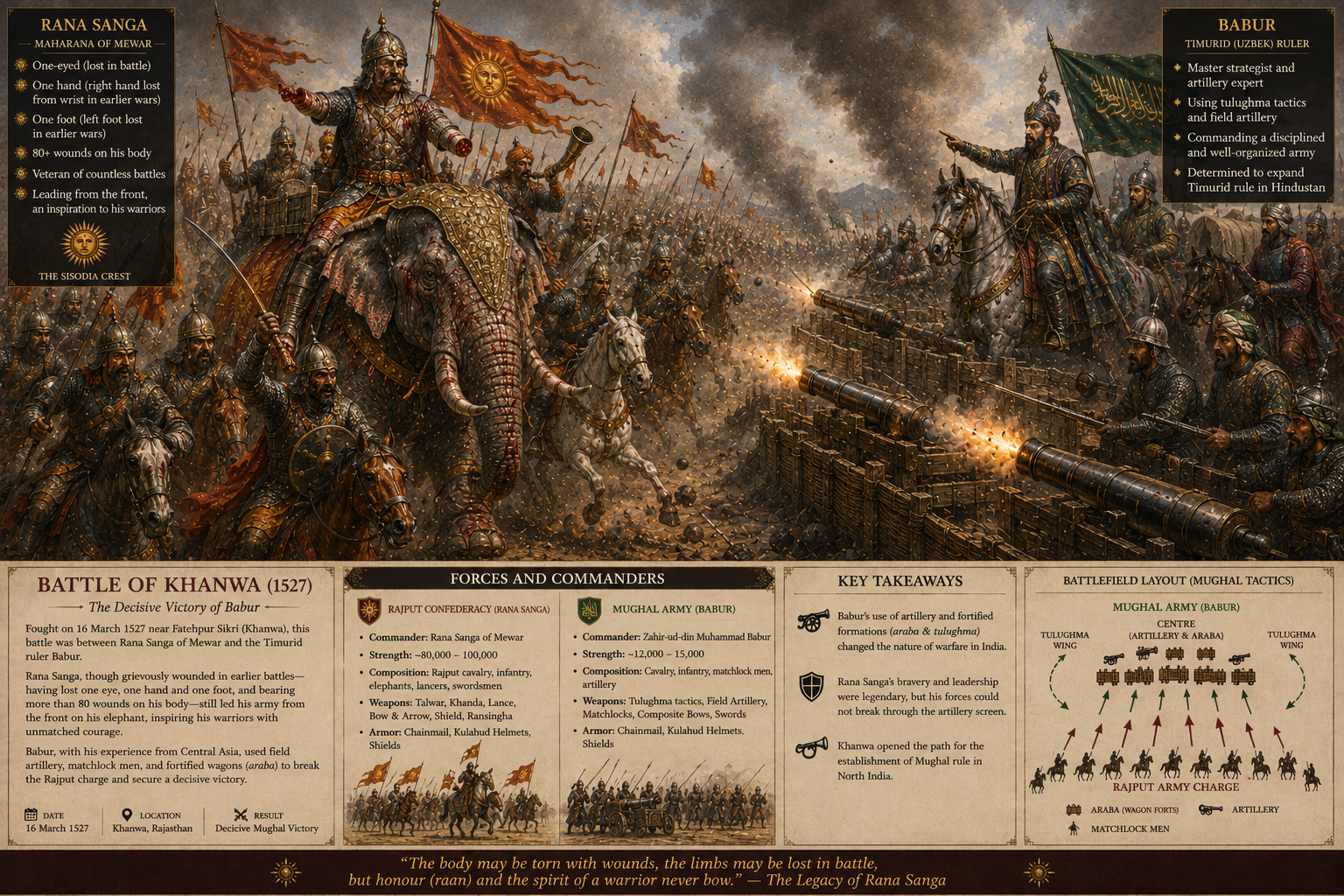
In the spring of 1527, less than a year after Babur defeated Ibrahim Lodi at Panipat, his position in North India was still anything but secure. The Lodi sultan was dead, but the political contest for the Indo-Gangetic plain was not. To the west stood Maharana Sangram Singh of Mewar—Rana Sanga—whose authority and reputation had grown through years of warfare in Rajasthan and Malwa.
Khanwa was therefore not simply a clash between “Rajputs and Mughals.” It was a contest over who would shape the political order that followed the collapse of Lodi power. Around Rana Sanga gathered a broad confederacy of Rajput chiefs and other allies. Babur, meanwhile, had to convince an army far from its Central Asian homeland that Hindustan was worth fighting for—and that retreat was not an option.
Rana Sanga: a veteran at the head of a confederacy
Tradition remembers Rana Sanga through the injuries accumulated over his military career: the loss of an eye, severe damage to limbs, and numerous wounds. The precise tally of “eighty wounds” belongs to later historical memory and should not be treated as a battlefield medical record, but the larger point is well supported: Sanga was already an exceptionally experienced war leader before Khanwa.
His strength lay not merely in personal courage. Mewar had become a major regional power, and Sanga could draw fighting contingents from multiple chiefs. This gave the confederacy formidable shock power—especially cavalry accustomed to aggressive close combat—but it also meant that battlefield cohesion depended upon many separate commanders acting together.
Babur's problem: how do you stop the charge?
Babur had already demonstrated at Panipat that gunpowder weapons were most effective when combined with field engineering and manoeuvre. At Khanwa he again organized a protected centre around carts or wagons, defensive obstacles, matchlock men and artillery. The purpose was not to let cannon win the battle by themselves. The line was designed to disrupt and channel an assault while Babur retained mobile cavalry on the wings.
His memoirs make clear how seriously he regarded the coming fight. Before the battle he sought to stiffen morale, publicly renounced wine and framed the campaign in religious terms. Whatever we make of that rhetoric, it reveals something important: Babur did not regard victory as automatic.
The drama of Khanwa lies in the contrast: a confederacy built for violent offensive shock against an army trying to absorb that shock, break its rhythm, and counterattack.
The charge toward the Mughal line
The Rajput-led attack was not a timid advance into cannon fire. Contemporary and near-contemporary narratives describe hard fighting and serious pressure on Babur's positions. The confederate forces attacked aggressively, and parts of the Mughal army were tested severely. This is the scene our reconstruction emphasizes: cavalry and supporting troops pressing toward a defended artillery-and-wagon position through smoke, noise and confusion.
Early sixteenth-century cannon were not modern rapid-fire weapons. Their importance lay in the combined system around them—noise and projectile effect, protected firing positions, matchlocks, obstacles, reserves and mounted troops able to exploit disorder. A determined cavalry assault could still reach the enemy; the question was what condition it would be in when it arrived and whether the defenders' formation would hold.
Artillery, araba and manoeuvre
Babur's tactical method is often reduced to two words: artillery and tulughma. That shorthand hides the real innovation. His battlefield system combined several elements. The centre was strengthened by carts and defensive arrangements; firearms operated from protected positions; gaps allowed troops to move through the line; and cavalry on the wings could attempt enveloping movements once the enemy had committed itself.
In other words, Khanwa was not “guns versus swords.” Both armies possessed complex mixtures of cavalry, infantry and missile weapons. Babur's advantage was the integration of gunpowder, field fortification and mobile cavalry into a coordinated plan.
When momentum began to turn
As the struggle continued, the confederacy failed to rupture Babur's centre decisively. Pressure from Mughal cavalry and sustained resistance around the fortified line gradually changed the balance. Rana Sanga was wounded and removed from the field. In a coalition army built around his prestige, the command shock mattered enormously.
Once the assault lost coordination, Babur's system had the advantage it was designed to create: an enemy whose forward momentum had been spent could now be attacked by more mobile formations. The battle ended in a decisive Mughal victory.
Why Khanwa mattered more than Panipat alone
Panipat gave Babur Delhi and Agra; Khanwa helped him keep them. The defeat of Rana Sanga removed the most powerful immediate military challenge to Babur's new position in North India. It did not end Rajput power, nor did it make Mughal supremacy inevitable, but it greatly improved the chances that Babur's conquest would become a dynasty rather than another short-lived invasion.
For the Rajput side, Khanwa also became a story of courage against a changing battlefield system. That memory should not be romanticized into the claim that bravery alone determined outcomes. The more interesting history is precisely the opposite: extraordinary personal courage could coexist with tactical disadvantage, coalition problems, command disruption and technological change.
What the popular version gets wrong
“Babur won only because he had cannons.”
Too simple. Artillery mattered, but so did protected deployment, matchlocks, cavalry manoeuvre, discipline and command.
“The Rajputs simply rode helplessly into gunfire.”
Also misleading. The fighting was hard, the Mughal position came under pressure, and the assault had to be defeated through a combined defensive and mobile system.
“Khanwa ended Rajput resistance.”
No. Rajput states remained major political and military actors for centuries. Khanwa changed the balance of power; it did not erase Rajput power.
Sources & reading trail
Primary / near-contemporary:
- Baburnama (Memoirs of Babur), especially Babur's account of the Khanwa campaign and battle.
- Nizamuddin Ahmad, Tabaqat-i-Akbari, for the early Mughal political narrative.
Useful modern editions and studies:
- Annette Susannah Beveridge (trans.), The Babur-nama in English.
- R. P. Tripathi, Rise and Fall of the Mughal Empire, for political and military context.
- G. N. Sharma's work on Mewar and Rajasthan for the Rajput political setting.
Editorial note: Numerical estimates for the armies and some details of Rana Sanga's wounds vary substantially between traditions and historians. Ankaha Bharat avoids presenting disputed figures as settled fact.